

Prior to mid-March, a casual observer of UK news media could be forgiven for believing that climate change had been solved and that Net Zero had ceased to be a problem. The publication of the Intergovernmental Panel on Climate Change (IPCC) 6th Assessment Report (AR6) on 20 March should have corrected that impression. Earlier in the year, and unnoticed by many, the UK published its own independent assessment of progress towards net zero: Mission Zero, Independent Review of Net Zero, led by Chris Skidmore MP. Mission Zero was remitted by then Secretary of State for Business and Energy, Jacob Rees-Mogg in September 2022 and presents a comprehensive assessment of the UK’s net zero targets and how the nation is doing in meeting them.
The tone and content of the reports, offering both encouragement for action and continued warnings about the consequences of failing to act, show that their authors recognise that the argument for Net Zero by 2050, whilst clear and compelling to them, is not yet won. Indeed, in the UK prominent sections of the national press continue to argue that action is either unnecessary or should be at least delayed. And in government circles there is no doubt that the shorter-term costs of achieving Net Zero remain a major focus, with less apparent consideration and publicity given to the likely-longer term impacts and costs of not reducing emissions and mitigating climate change.
In late March the UK Government published a draft of its National Policy Statement for National Networks (NPSNN), updating policy to reflect the commitments it has made on decarbonisation, climate change, and sustainability. This document sets out Government’s policy framework for the development and delivery of nationally significant infrastructure projects (NSIPs) on England’s road and rail networks. Importantly, it provides the main basis for Government’s assessment and decision making regarding development consent applications for NSIPs on those networks.
So, what do these three highly significant documents foreshadow for our society – and for our transport networks?
IPCC’s AR6
The IPCC’s AR6 is clear and confident that “climate change is a threat to human well-being and planetary health”, that “there is a rapidly closing window of opportunity to secure a liveable and sustainable future”, and that what we do in the next seven years or so will have significant impacts now and for thousands of years to come: a position perhaps best paraphrased by Jay Inslee, Governor of Washington State when he said: “We are the first generation to feel the sting of climate change and we are the last generation that can do something about it!”. AR6 also concludes rather dryly that “worldwide climate resilient development action is more urgent than previously assessed in AR5”.
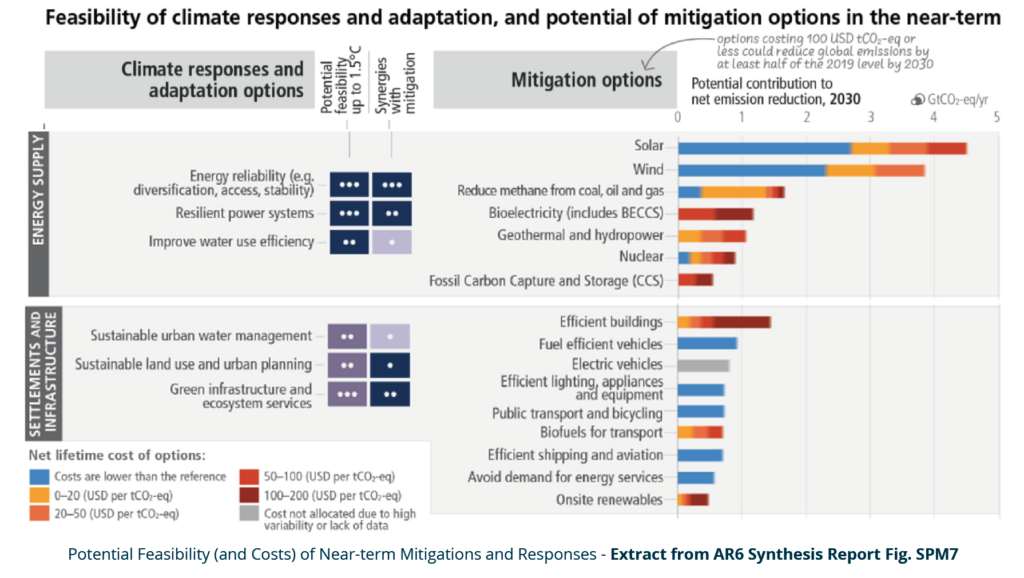
In pointing to the multiple opportunities to increase climate action, AR6 is also clear that development of public and active transport is, along with solar and wind power, and fuel efficiency in all transport, one of the lowest cost ways of delivering reductions in greenhouse gas emissions.
Mission Zero
Part 1 of Mission Zero concludes that net zero 2050 remains the right target for the UK to pursue, highlights the many growth opportunities that target presents, and explains some of the challenges it poses. Part 1 concludes that the government is not on track to achieve net zero and that it must take significant further action if that objective is to be achieved. Perhaps surprisingly, it does not include transport, still the UK’s largest source of CO2 emissions, in its list of economic sectors posing particular risks to net zero. Part 1 sets the scene for the 129 recommendations to Government contained in Part 2 of the report.
Part 2 of Mission Zero groups those recommendations under six “Pillars”. Pillar 1 covers the need for certainty, continuity, clarity, and consistency in Government policy: something of a novel concept given recent UK political history. Pillar 2 addresses the security and development (expansion) of the energy sources and transmission networks necessary to largely electrify the economy to achieve net zero. Pillar 3 considers economic incentives, and it is not until Pillar 5 “Net Zero and the Individual” that transport is fully addressed.
At that point Mission Zero’s messages become much more aligned with the IPCC’s, acknowledging that as the cost of electrically powered motoring is likely to fall, unchecked, road congestion could rise nearly four-fold with the cost of congestion increasing from £59.5bn to £121.5bn by 2040. The report recommends honest and open engagement with the public to communicate the need to reduce car journeys together with the benefits of doing that. Noting that since 2010 the cost of passenger rail travel has risen at nearly twice the rate of car travel (and that the costs of bus travel have risen even more spectacularly), the report recommends that Government acts to reduce the costs of public transport.
Stressing the need, going forward, to place intermodality at the heart of transport planning, the report draws some unfavourable comparisons between UK developments and those in Germany and France. In contrast to the lack of quantified
national transport targets south of the border, it also notes the Scottish Government’s move to set numerate targets for reducing road journeys and increasing those by active travel (walking and cycling) and by public transport. Looking at electric cars, the report highlights the slow pace of charger installations and the persistent price gap between home and public charging, with the latter typically 2 to 3 times more expensive than the former.
National Policy Statement
for National Networks
The draft NPSNN is a significant advance on its 2014 predecessor, which was silent on climate change and net zero. The policy statement clearly states Government support for rail transport, albeit qualified by uncertainty over post pandemic growth in traffic levels and concerns over financial sustainability. Support for modal shift of passenger traffic to public and active transport is mentioned briefly, but the document focuses strongly on encouraging modal shift to rail in the freight transport sector, setting out at some length the case for strategic freight interchanges and suggesting that in some circumstances rail capacity should be reallocated from passenger to freight use.
The policy statement notes that electrification, together with “use of alternative technologies” will be required to fulfil the policy commitment to phase out the use of diesel-only trains by 2040 and enable a net zero railway by 2050. It also notes that the electrified railway is the only means of transporting heavy goods in a low-carbon way using existing, proven technology. The policy is clear that all public sector investment will require business case support and that such cases will include an assessment of societal and environmental costs and benefits, including contribution to decarbonisation.
Conclusion
Taken together the three documents described above paint a mixed picture. Government policy appears clear and supportive of low/no carbon technologies, but not at any cost. So far as real progress is concerned, whilst the power generation sector has made big advances there is still much the UK has to do in the wider economy, and much of that depends on coordinated Government action in the fields of policy and regulation. The absence of clear intermediate carbon targets makes assessment difficult, but it is apparent that the country isn’t yet where it needs to be on the path to decarbonisation.
In policy terms, public transport is acknowledged to be part of the decarbonisation solution. Clear plans are being made in Scotland and strategy is being developed in some English regions, witness the recently published Transport Strategy for the Southeast. The current national Government’s support for rail is present but clearly conditional and often ideologically coloured. When considered with enduring constraints on public spending, Treasury scepticism born of massive cost overruns on Great Western electrification and the Elizabeth Line, and growing concern over HS2 costs and timescales, there is still considerable uncertainty over rail’s position within Government’s plans. The industry’s challenge remains to convince Government not only of its ability to contribute significantly to decarbonisation, but to do so in a way that demonstrates clear value for money for the public purse.