
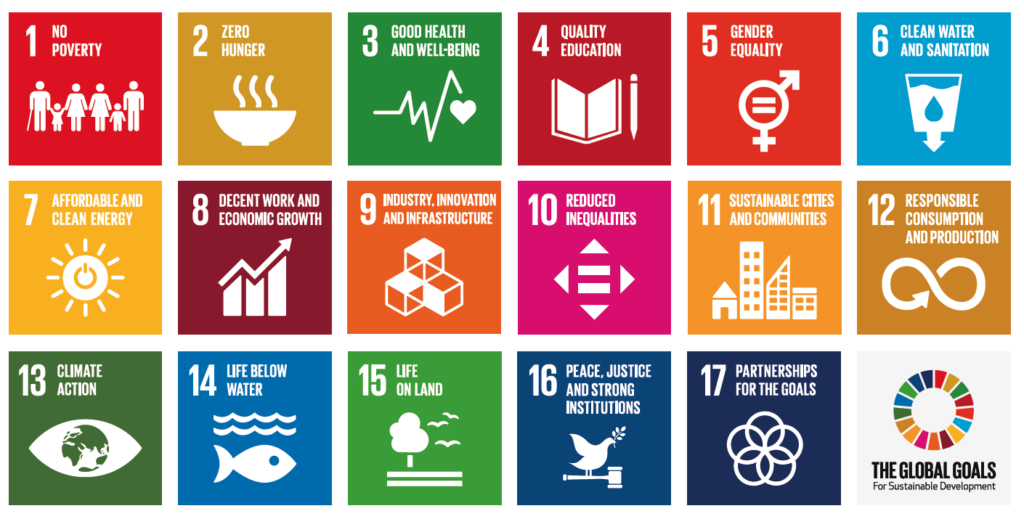
The Engineering Council’s Guidance on Sustainability Report outlines how professionally registered engineers and technicians can contribute to the UN’s Sustainable Development Goals, whilst achieving the core competencies set out in the UK Standard for Professional Engineering Competence (UK-SPEC).
The Engineering Council highlights six principles that support professional engineers and technicians to make sustainable decisions for clients, employers and society, these are:
1. Contribute to building a sustainable society, present and future;
2. Apply professional and responsible judgement and take a leadership role;
3. Do more than just comply with legislation and codes: be prepared to challenge the status quo;
4. Use resources efficiently and effectively;
5. Seek multiple views to solve sustainability challenges;
6. Manage risk to minimise adverse impact and maximise benefit to people and the environment;
Further guidance on these principles can be found on the Engineering Council’s website www.engc.org.uk/sustainability.
PWI’S COMMITMENT TO SUSTAINABILITY
The PWI competence and commitment criteria fully comply with UK-SPEC and requires an enhanced focus on safety where candidates must demonstrate their absolute commitment to the application and improvement of staff and system safety.
Recognising the increasing criticality of sustainability in railway transport, the PWI have enhanced the focus on sustainability within the criteria, and candidates must demonstrate their understanding of sustainability and commitment to its application.
Those seeking Professional Registration are encouraged to reflect on the United Nations 17 Sustainable Development Goals when demonstrating their competence in this area. Applicants should be aware that sustainability is far-reaching and can be linked to many aspects of work and personal lives.
To support those seeking Professional Registration and our existing members, a joint working group drawn from the Environmental Sustainability and the Membership Committees was formed to look at our existing guidance and understand how members can best demonstrate their commitment to sustainability.
Supporting documentation has been created that aims to explore the requirements and provide example case studies for members to reflect on their own contribution to sustainability. The first of these focuses on those seeking Professional Registration and aims to provide examples of activities, with a varying degree of commitment & competence depending on the candidate’s intended level of registration. On our website you can download a table giving examples of how candidates for professional registration can demonstrate the Sustainability Competence E3.
IMPLEMENTING THE 17 SUSTAINABILITY DEVELOPMENT GOALS
The railway engineering industry is integral to achieving the 17 United Nations Sustainable Development Goals (SDGs). Railway Engineers play a vital role in promoting sustainable transportation, reducing emissions, and enhancing infrastructure.
Below we have highlighted four of the goals that you could use as a starting point for making your working practices more sustainability focused.

4.Education liberates the intellect, unlocks the imagination and is fundamental for self-respect. It is the key to prosperity and opens a world of opportunities, making it possible for each of us to contribute to a progressive, healthy society. Learning benefits every human being and should be available to all.
9.A functioning and resilient infrastructure is the foundation of every successful community. To meet future challenges, our industries and infrastructure must be upgraded. For this, we need to promote innovative sustainable technologies and ensure equal and universal access to information and financial markets. This will bring prosperity, create jobs and make sure that we build stable and prosperous societies across the globe.
10.Too much of the world’s wealth is held by a very small group of people. This often leads to financial and social discrimination. In order for nations to flourish, equality and prosperity must be available to everyone – regardless of gender, race, religious beliefs or economic status. When every individual is self sufficient, the entire world prospers.
13. Climate Change is a real and undeniable threat to our entire civilisation. The effects are already visible and will be catastrophic unless we act now. Through education, innovation and adherence to our climate commitments, we can make the necessary changes to protect the planet. These changes also provide huge opportunities to modernise our infrastructure which will create new jobs and promote greater prosperity across the globe.