

This article is a personal reflection from Richard Hill, a current Member of the PWI’s Environmental Sustainability Committee.
In a world where sustainability has become the buzzword of the century, the quest for eco-friendly practices extends beyond reusable bags and electric cars. To engineer a green future we might be best placed to look to the past through the bottom of a pint glass or two. Enter the world of real ale, micro pubs, and the circular economy.
You may be lucky enough, like me, to live in Derbyshire, the greatest county in the UK,. Those of you from other counties may challenge my assertion and I’m happy to debate this ‘fact’ over a pint in any of the micropubs, that have sprung up all over the rail network. I say it’s the greatest considering the evidence presented. In my borough alone, Amber Valley, we have a UNESCO World Heritage site dedicated to the birth of the factory system at the outset of the Industrial Revolution. It’s home of the last armed revolution in the UK, possibly the oldest surviving lineside station building left, picturesque landscapes, fantastic rail links and birthplace to many a great citizen. One of whom is a champion of the next industrial revolution, the circular economy, Dame Ellen MacArthur.
Your perception when gazing into a part supped pint glass is dependant on your disposition. It’s either half full or half empty. If like me you’re an optimist, it always contains more to enjoy and of course the beauty of a glass in a pub is you can always refill and reuse it. Better still, the cask or keg it came in can be similarly reused when it’s time for a refill. If it happens to be a crafted barrel even better as a skilled cooper can always repair it to maximise its useful life.
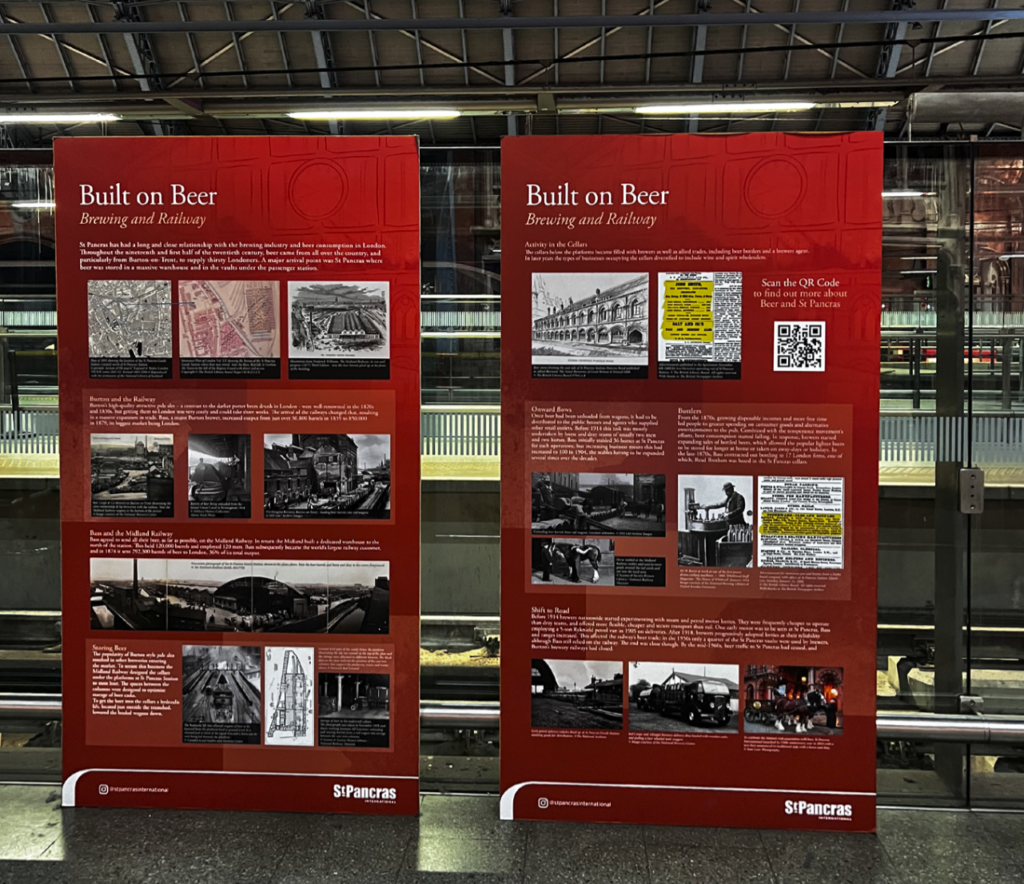
Travelling south from Derby by train, the natural southern final terminus is St Pancras station with its fine arched roof made in Amber Valley by the Butterley Engineering Company in the 19th century. Things were very different then, the undercroft at the station wasn’t the rail terminus to Europe nor was it the shopping experience it is today. It was a beer warehouse with the columns spaced at 14ft intervals, designed to accommodate barrels that came from Burton upon Trent on the train for storage and distribution in the capital and then use again. The Victorians understood there was value in the packaging and therefore engineered a circular recycling system to preserve investment in the containers.
Somewhere along the way however we have lost our sense of direction and it may be time to start things going round in circles again. Not a meeting action that never gets done, as we have all possibly experienced, but a new design philosophy in line with the UN Sustainable Development Goal number 12: Sustainable Consumption and Production, transitioning to a circular economy. It’s time we engineers really begin again to think about how we design and maintain the railway. This is where some real personal commitments come in. Not “I will recycle everything I can at home”, that’s the job of everyone right now. I mean us! The ones with the power to change the system, ensure that we embed circularity right from the design stage or finding new uses for existing waste.
But how do you change the system?
Looking back in the history of Amber Valley, we find a man called Jeremiah Brandreth. Not born in Derbyshire, he was the leader of the last armed revolution in the UK back in 1817. This was a time of mass unemployment, rising prices, a prior poor harvest and a broken political system activists were attempting to change via an armed uprising. The movment starting near South Wingfield and by the way of a few pubs gathering people along the way, several hundred revolutionists, came through my hometown of Langley Mill, ending up a few miles away in Giltbrook. Here it all came to a sticky end with arrests and sadly for Jeremiah, the ignominy of being the last man to be beheaded in England outside Derby Gaol.

Returning to my 3/4 full glass. After listening to some of the world’s most eminent scientists and speakers on the subject of climate change, some I have even had the pleasure of meeting. one common theme crops up as they describe the problems of achieving climate change adaptation, mitigation and circularity. The language used around the subject isn’t always understood by politicians or the public. Standing, as I have done before, in Parliament Square, in a white coat with other scientists holding placards and banners with slogans like ‘system change not climate change’ may be well understood by those in the group and maybe some passers-by and some of the elected officials. but not everyone!

A ½ full glass now helps see that great strides have been made in the last decade with renewable energy generation and the sales of EV vehicles continuing to rise. But this cannot and will not solve all the problems. That is where we come into play, as environmentally aware engineers. No matter what your role in the rail industry, we all have a part to play. Rail transport is the most efficient and cleanest way to travel and the best way to move freight but we need to get even more efficient as an industry and look to some of the ways of the past and make circular by design, business as usual.
In my now 3/8 full glass of real ale which aligns with the principles of the sustainable circular economy, where the packaging was designed to have a longer life cycle, reducing waste and environmental impact. The traditional craft of brewing real ale fosters a connection to local ingredients and communities, making it a natural fit for the circular economy ethos. But why do I keep referring to ale? It’s about finding a common language and goal. It’s very easy to demonstrate the idea of circularity if the subject matter is familiar to a very large part of your audience. I could have chosen the milkperson but sadly the sight of a milkperson is not as common as it used to be. My time delivering the daily pint is long gone. A change in public habits put an end to the traditional milkround. Having said that, milk deliveries are making a comeback. Similarly train travel is again increasing, the leisure market is thriving, and we can all play a part in making that trend continue. One very easy commitment to make, and we all can do it (and as workers of the industry we should) is to use the train when we travel. There is a huge nostalgia for train travel in this country. Some of the most iconic movie moments of the 20th century involved trains. Carnforth is yet to be visited by me for leisure; I did have a brief encounter there once, but only looking into a trackbed trial hole. Some of the great 21st century movies have, and no doubt will continue to use rail as a backdrop.
But while this glass, as I write, is now 1/4 full, that’s where hope and optimism come into play. We have young apprentices and graduates coming on board this journey. They will need help and guidance from the experienced, not to show old techniques or outdated methods, but to offer words of encouragement, guidance and most of all the benefit of a voice that can carry more weight for their new ideas. Those coming into the industry will have fresh ideas and new ways of thinking. However, their ideas can get drowned out and lost. It can be demoralising if all they hear is “We have always done it like this”… which we haven’t by the way! The new generation must have access to corporate memory, something that can get lost along the way as organisations change.
This year marks 140 years of the PWI and I wonder what our forebears were thinking at that time. What were their goals? The fact is they have left a legacy in this Institution and the infrastructure that they and their later peers have left behind. But now we stand in that very same position, we can wonder what we will leave behind. The definition of sustainability is ‘to serve the needs of the current generation without detriment to future generations’. That is something we can do exceptionally well. This leads to some very tricky questions that may even get debated well into the night with no easy answer. Questions like ‘How do we finance what’s needed?’, and ‘Why should this generation bear the cost?’. If you look at the investment markets, fossil fuels attracts huge investment but in time that will change. The railways could look very apealing as a long-term stable investment platform. However, we need stability and a robust long-term strategy that will last decades, reducing operating costs improving safety and remaining profitable. Moving towards circularity could look very attractive to those who want to invest in a greener future. We need to change what we do! Not at a snail’s pace though, but at the rate at which the climate is changing.
Railways drive change in the communities we serve, and new lines or reopening older lines bring investment. We have some great products out there that could be fully circular, and we need a lot more. From the PPE we wear to the heaviest of components that we use. We need a full rethink of the way we do things. Rail can be cascaded as well as S&C etc. Ballast can go for a second life elsewhere. I have lost count of the times I’ve seen materials discarded along the line and it begs the question, if you were an investor looking at a factory would you invest if it looked like a dumping ground? If I were to go even further and seek huge investments I would advocate for a second Channel Tunnel. We could get huge swathes of people away from air travel if you look at some of the work done by SilverRail, for example, demonstrating in terms of time and cost that rail travel can be an affordable and potentially a quicker alternative to flying in some cases. It’s time to be bold and ambitious and reignite that Victorian sense of an ability to change the world albeit in a way that doesn’t harm the environment.
Watching life go by on my days off in a platform pub is a firm favourite of my pastimes. It allows some contemplation time. We are all cogs in a very big machine and we each play our part. Dame Ellen talks about resources on a ship as she sailed around the world and some of you may have read the works of Buckminster-Fuller and his notion of spaceship earth. But how many people do we need to convince that circularity is the way forward? So start small by finding the common goal that will inspire change but more importantly, be the change yourself. There are some very quick easy wins, a refillable water bottle rather than plastic. The same goes for a travel mug. Once you peer through the circular looking glass it’s very hard to see the world the same again. It’s not like going down the rabbit hole, it’s more like a wormhole! If you want to know more there are some great reads you can find in a local library and if you can’t find one, I’m sure any helpful librarian will order you one in. So go and find a nice spot to relax, read, and enjoy your journey as we hurtle around the galaxy together on our little lump of rock.
References UN Sustainable Development goal No 12
www.globalgoals.org