

ELECTRIFICATION
I hope you enjoy the theme for this Journal, which is “electrification” for two reasons; firstly, because it is such an important agenda item for UK decarbonisation, and secondly, because the PWI is now the Institution for electrification as well as track and structures.
When we electrify the railway, we need to consider all those key technical areas that we as pway engineers are familiar with, from geotechnics to track curving and fixity through to the tricky subject of… wait for it… clearances. See Phil Holbourn’s presentation Very reduced Electrical Clearances (images 1 & 2) at the PWI South and West Wales Section meeting on 9 November 2020 – you’ll find this on YouTube.
REFLECTION
With almost a year of limited personal social interaction due to Covid-19, the PWI has been remarkably successful in enhancing our technical services to Members and I thank you all for staying with us and contributing to shared knowledge.
It seems to me that many people have gained possibly more than expected through the opportunity of virtual training and a vast variety of technical presentations. It has been a good period for online national events with the Automated Railways Seminars that took place on 17 September and 8 October in conjunction with IRSE, IET and IMechE, ably organised by Andy Packham. Network Rail continued with their half-yearly Technical Engineering Conference for Capital Delivery on 30 September. Both were very well attended with excellent speakers.
The last PWI full in-person event was Manchester’s excellent NW Seminar in March 2020, which will be succeeded by the event “Hit the North” later this year, hopefully as a blend of in-person and virtual.
SUPPORTING THE INDUSTRY
The PWI is in a superb position to support the industry as we bring our professionalism in track, structures and electrification together through meetings, seminars, training and publications.
I trawled through the past seminar presentations and the following sets of excellent and up-to-date presentations popped up on the website. I also recommend that you look at some of these – they make excellent CPD!
- 25 April 2018 – Railway Junctions: The electrification challenges
- 24 April 2019 – Electrification and PWay Developments
We are continuing to focus on these subjects, and I will be delighted to see you there in person at our next event – so don’t forget to book for our first Covid-free (hopefully) seminar in Scotland which is being finalised by the team in conjunction with the Glasgow Section.
The technical team at the PWI will continue to focus on our theme of expanding and improving current technical knowledge of permanent way in all those areas which are important to the safety of both staff and users. The ultimate concern, of course, is where there are risks of derailment. There have been a number of recent incidents in switches and crossings layouts UK wide.
I recommend that you look at the RAIB website to get further information and understanding of where things have been missed, gone wrong or just simply been a combination of things involving the rolling stock wheel and rail interaction.
You know that we continue to focus our training in areas where we can give the most value to the industry and this is clearly the case in our specialist area of knowledge of railway junctions, particularly points, switches and crossings. We have just passed out 24 PWI engineers having completed their training in S&C Refurbishment (see images 3 & 4).
RAIL APPRENTICES GRADUATE TRAINING AND EDUCATION
We are continuing to work on competence frameworks that link to suites of training courses provided throughout the industry in the UK and Ireland. They also provide the springboard to PWI professional registration, especially with regards to qualifications and BTEC/HND/Degree apprenticeships. This is seen as a key move to enhance PWI membership and forge the advantages of registration.
I presented the benefits of PWI membership to 147 Network Rail new apprentices and the PWI has since had an influx of student/apprentice Members. It was good to receive many questions from the young new industry starters, including, “what is the PWI doing about Climate Change?” Well, I am duty bound to formally respond…
RESILIENCE OF RAILWAYS AND CLIMATE CHANGE
The three major influences of Climate Change upon UK railways are temperature increases, emissions and exceptional weather. Average mean temperatures have been rising since the stress-free temperature of continuous welded rail was set at 27oC by British Rail Research in the 1960s.
Exceptional and unusually severe localised storms washed material on the track in Scotland in August 2020 and caused a derailment fatally injuring three people (see images 5 & 6). Sadly, it was not easily predictable, and work has begun to enhance procedures for forecasting weather and the impact on earthworks. It is a great credit to our rail infrastructure colleagues for the emergency efforts that has enabled the line to be reopened.
I was privileged to be the keynote speaker at a Rail Conference in Berlin on 28 September hosted by the German Non-Destructive Testing Institute. Unfortunately, it was virtual and should have been alongside the Innotrans Rail event. However, I held their interest on the UK approach to Climate Change and Track Maintenance.
Rest assured that the PWI will continue to provide up to date knowledge, skills, and if needed, training, to enable us to promote the concept of resilience to deal with Climate Change.
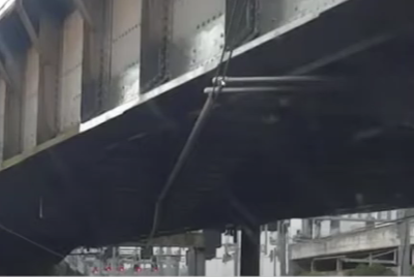
Image 1: Cardiff Intersection Bridge
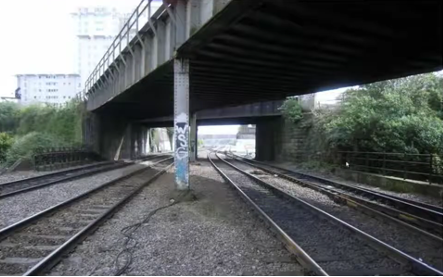
Image 2: Cardiff Intersection Bridge
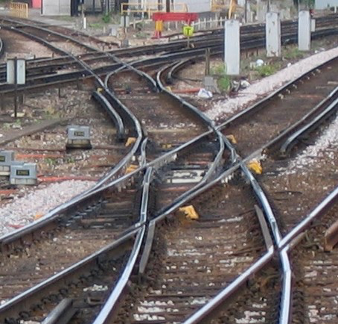
Image 3: Switches and Crossing refurbishment before and after (images by Dave Ratledge and Roy Hickman on PWI training course)
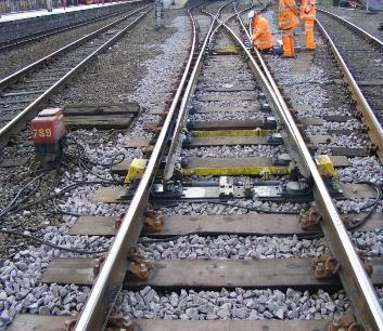
Image 4: Switches and Crossing refurbishment before and after (images by Dave Ratledge and Roy Hickman on PWI training course)
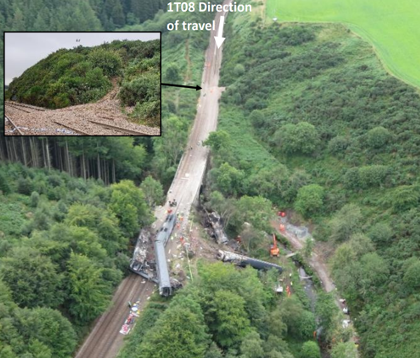
Image 5: Stonehaven Derailment August 2020, inset the washed out material and right repairs well underway in October 2020 (image courtesy Network Rail Resilience of rail infrastructure interim report to the Secretary of State for Transport following the derailment at Carmont, near Stonehaven, Andrew Haines, CEO 01-09-20; RTM)
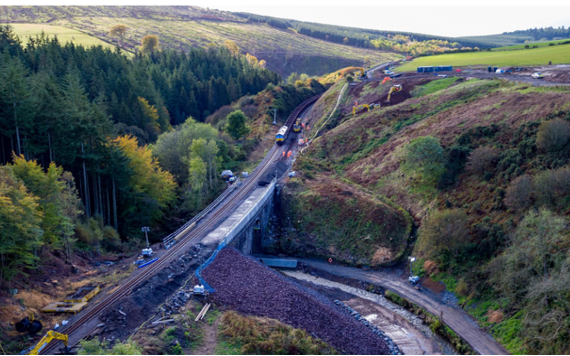
Image 6: Stonehaven Derailment August 2020, inset the washed out material and right repairs well underway in October 2020 (image courtesy Network Rail Resilience of rail infrastructure interim report to the Secretary of State for Transport following the derailment at Carmont, near Stonehaven, Andrew Haines, CEO 01-09-20; RTM)