

Welcome to another issue of The Journal – packed, as ever, with a fascinating mix of technical topics and more people-focussed articles. Recent travels in Scandinavia (of which more later) reminded me that the great challenge of public transport is both getting the engineering right and looking after the travelling public while they experience our ‘production line‘ at close quarters. The latter is not just about moving people, it’s also about making them aware that they are being, and will be, cared for while travelling on our infrastructure, and beyond it. That way lays a successful public transport sector and a successful railway industry.
And in that spirit, having used my pieces in the last two Journals to talk extensively about our Institution and its future, I thought those who read my articles deserve a bit more variety with some discussion of wider topics. Before moving on however, as those of you who were at our AGM on 5 July will already be aware, I must quickly note that the Board has deferred putting a special resolution on name change to the membership.
Name Change Resolution Deferred
Our fellow Professional Engineering Institutions (PEIs) are keen to ensure that a PWI name change does not introduce scope for confusing PEI identities to the extent that people join the ‘wrong‘ Institution or seek technical support from one body where another would be better placed to provide it. The PWI having been in the business for 140 years, I am certainly keen that under its new name it should not be confused with any other body. The Board is therefore discussing further naming options with colleagues in other PEIs with the intention of arriving at a new PWI identity which is clearly differentiated. (It’s good to report that these discussions are also looking at how we can improve mutual cooperation and coordination.)
Such discussions inevitably take time, so a special resolution on the new name will not be put to Members before mid-Autumn this year, and it may yet be 2025 before this is practicable. A further matter
I must stress is that all PWI Members will be entitled and able to vote on the resolution. The PWI is and will remain a firmly democratic Institution!
Rail Live 2024
On a somewhat lighter note, it was great to be part of the PWI team on our stand at this year’s Rail Live, the UK’s largest outdoor railway industry exhibition. The main purpose of the Institution’s presence is to raise its profile and explain the benefits of membership to those who work in the field of railway engineering and who have yet to join us. In that respect this year’s event did not disappoint.
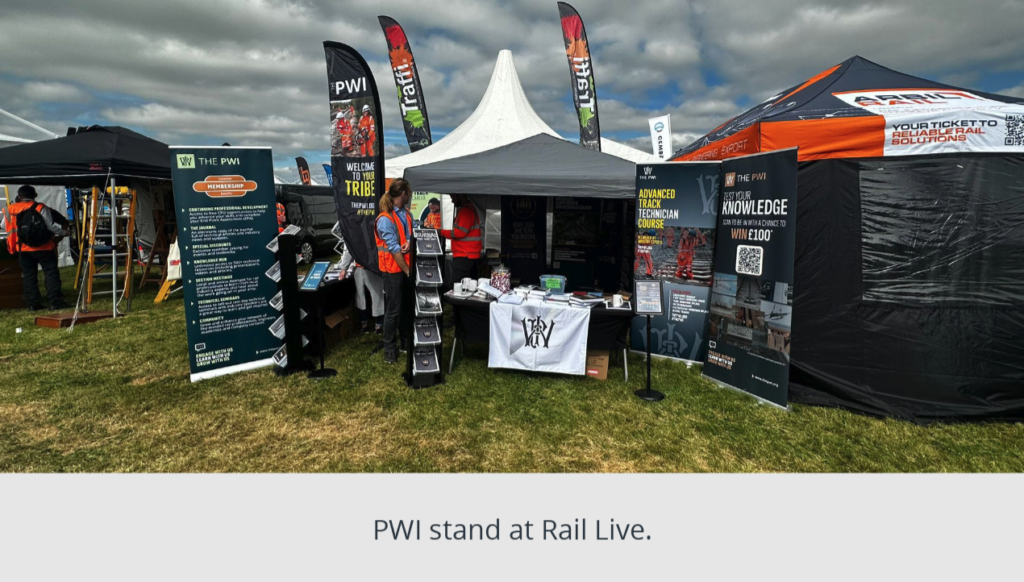
Following hard on the heels of our Seminar in Dublin (looking at developments on the Irish railway systems), and with the PWI’s London-based Electrification Seminar in sight, interest in our technical education programmes and the other opportunities we provide for personal and career development was higher than ever (and that’s despite the PWI being accidentally omitted from the list of exhibitors on the site information boards!). I look forward to welcoming into membership many of those who encountered the Institution for the first time, and I remain determined to further expand the scope of technical and professional support that the Institution provides.
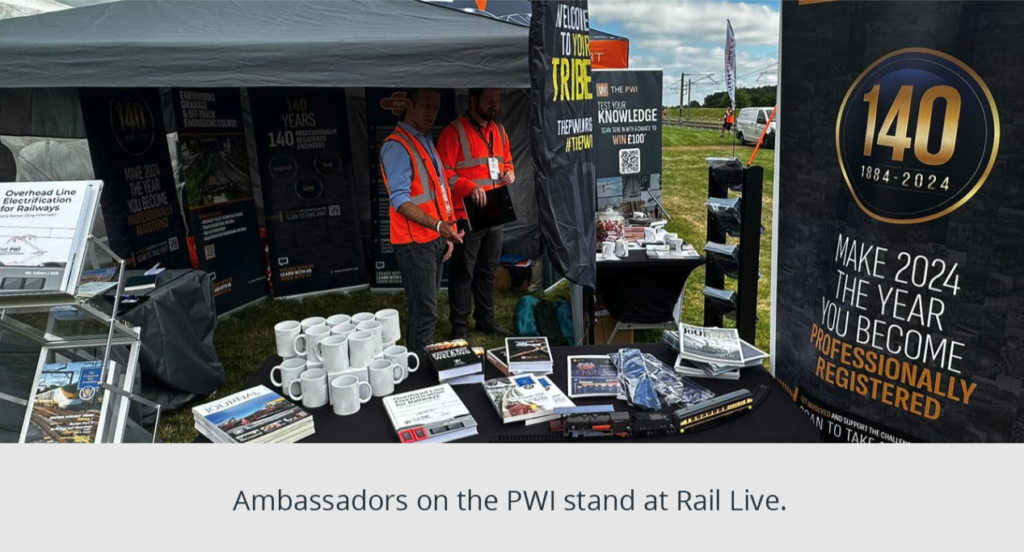
I never cease to be impressed by the enthusiasm and commitment of the Institution’s Ambassadors who manage our stand, and by the knowledge and experience of our Members who pop by to say hello and catch up on industry news and developments. It’s also great to have the chance to visit many of our Corporate Members on their stands, hear about current and planned technical advances, and view their latest ranges of products and services. Many thanks to all for the huge support given to the Institution.
The Heat is on
Literally… As I write, the UK is experiencing its first really sustained bout of warm weather this year. Whilst this made ‘holding the fort’ on the PWI’s stand at Rail Live a very enjoyable experience, railway engineers of all disciplines will be wary. Hot weather risks – including track instability, sagging electrification contact wire, and overheating electrical and electronic equipment – have the potential to seriously impact railway safety and performance, and I know that much thought and effort is being applied to ‘engineering-out’ and mitigating those risks on Britain’s railway networks. Thankfully, Summer 2023 didn’t see a repeat of 2022’s historically unprecedented temperatures, but climate science indicates we will see them again. Our railways can’t afford to be complacent and the evidence from Rail Live shows that companies in our industry supply chain are working very hard to develop increasingly sophisticated technology and techniques for inspecting and monitoring railway infrastructure, for modelling future performance, and for eliminating or reducing heat-related risk at source.
That said, to be effective, those technologies must be applied – and there are still significant challenges there. Our environment is changing and solutions that appear just about viable today may well not be so in the future – and railway assets are notoriously long-lived. If UK railways are to remain relevant – let alone flourish, many of the assets we install today must continue to perform in 25 years’ time or more, when heatwaves are likely to be five times more frequent and with air temperatures peaking close to 50˚C. If railway engineers don’t make the case for building ‘fit for the future’, who will?
Observations Abroad
A Spring holiday to Scandinavia by rail provided some interesting insights into how other European countries and railway administrations are developing their networks and how those networks are performing. It rapidly became obvious that the UK is not the only place where train service disruption and dislocation occurs when my wife and I arrived at Hamburg main station to catch a morning train to Denmark. A large fire in an industrial unit adjacent to the Rendsburger Hochbrücke (the famous bridge which carries the main North-South rail route high
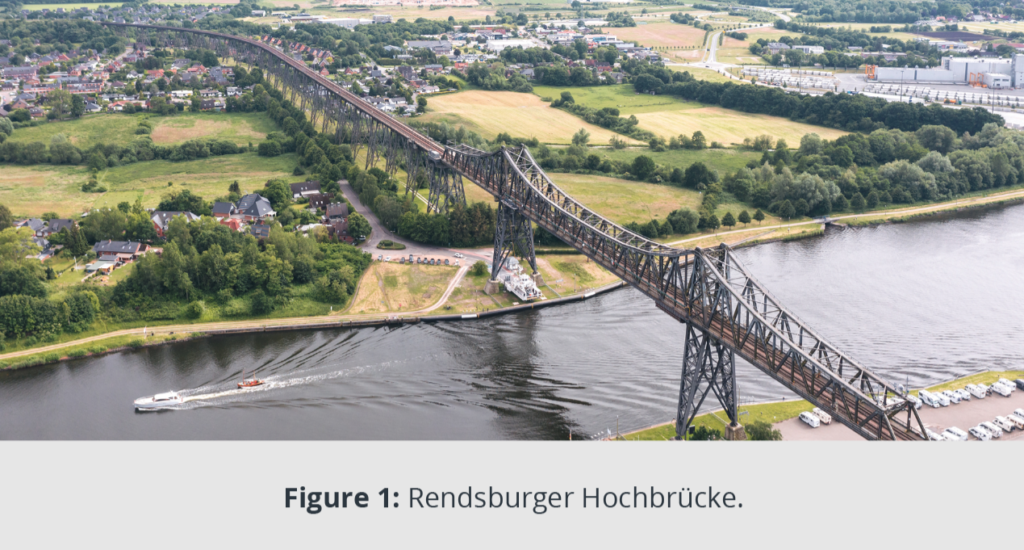
over the Kiel Canal) (Figure 1) had led engineers to close the bridge due to concerns over its ability to carry traffic loads without suffering permanent deformation. The steel structure had become so hot in places that the risk of ‘plastic’ deformation had to be taken very seriously. In the event rail services over the bridge were halted for the rest of the day and overnight.
So far, so understandable: but it then proved almost impossible to get sensible information about alternative travel arrangements. Discussion with other passengers and platform staff finally suggested a long detour via Kiel and then a rural branch line (itself disrupted by bridge reconstruction work enroute), resulting in a 6-hour late arrival in Sweden – that day’s destination.
It’s difficult to envisage how such external risks to railway infrastructure can be identified and mitigated, but I’m certain that better contingency planning and arrangements for providing travellers with information and support are feasible. Some three weeks later, one leg of our return journey through Germany was also disrupted due to a suicide in Berlin (300 km off our route, but the origin of our connecting train). This time, the delay was just under two hours and information on alternative travel arrangements was readily available. We had made a generous time allowance for shopping in Brussels, so thankfully managed to catch our scheduled Eurostar service back to London. As a result of these incidents, I now have practical experience of the German version of ‘delay-repay’ (which works quite well!). So most clouds seem to have some sort of silver lining…
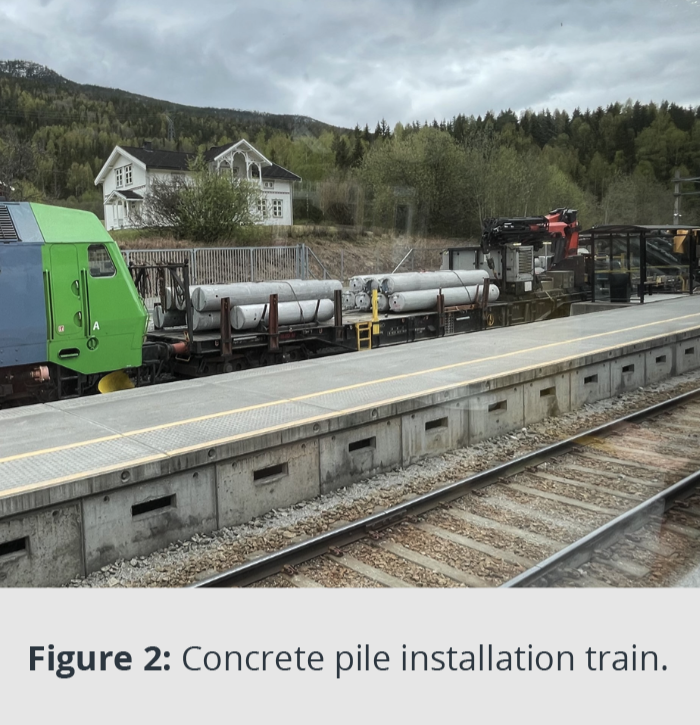
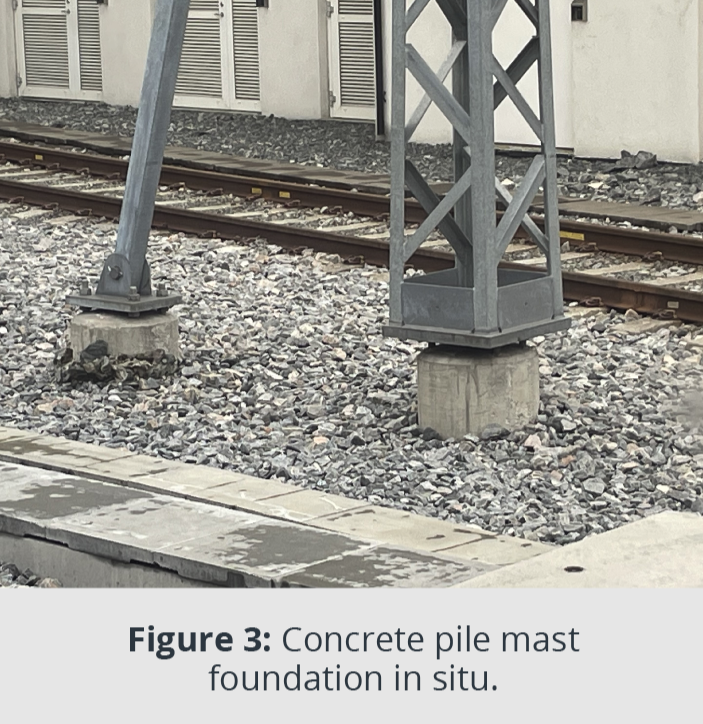
Back in Scandinavia, extensive investment by Norway and Sweden in their railway networks was clearly visible in work on new routes, track doubling, and electrification schemes, and it was interesting to see different engineering solutions to some familiar problems. The Norwegian approach to new and replacement electrification, for example, includes mast foundations formed from reinforced (or perhaps prestressed) concrete piles (Figure 2 and 3). Whilst I didn’t witness any installation in progress, it appeared that the piles were either driven into the ground (in a similar way to UK tubular steel mast foundations) or set up in previous excavations and then surrounded with in-situ poured concrete. I wonder whether these piles would suit UK geology in some areas and bring advantages in cost or carbon footprint?
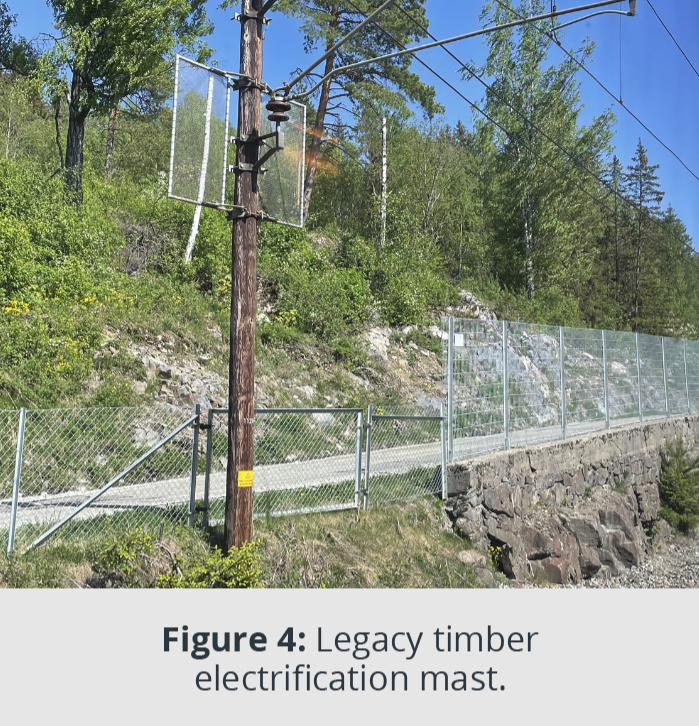
Older electrification schemes in Norway incorporated timber electrification masts and many of these remain in service, albeit being gradually replaced with modern steel masts. Those modern steel masts have obviously been designed to reduce material use (and thus embedded CO2). (Figure 4 and 5).

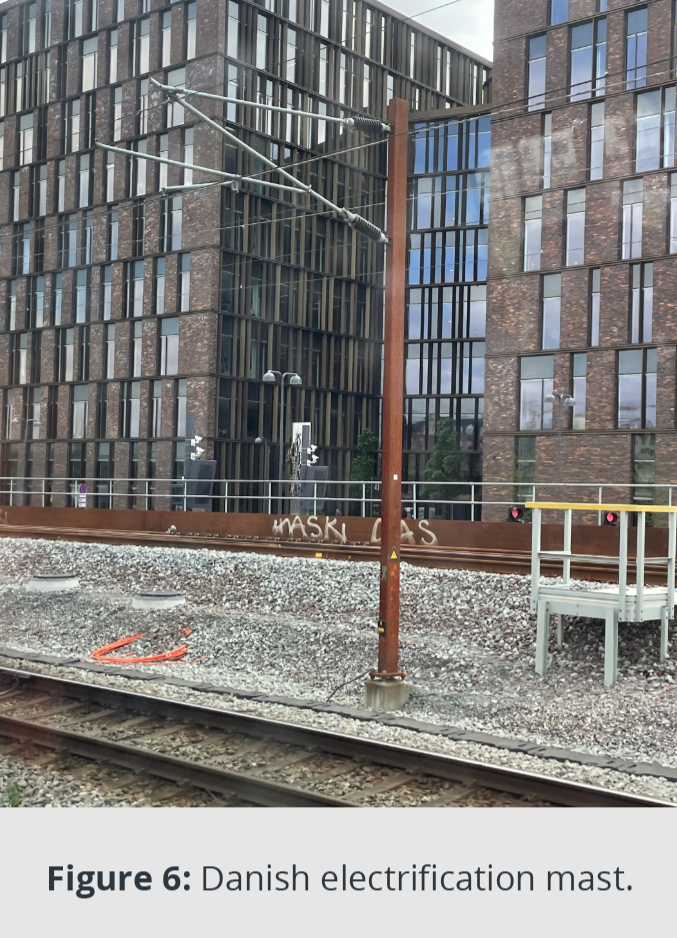
Interestingly, modern electrification masts in Denmark are brown in colour – due to a layer of iron oxide (rust) (Figure 6). This looks to be due to the use of a ‘corten-type’ steel: a steel alloy in which environmental protection is provided by a tenacious oxide layer which does not flake or laminate. The costs of initial galvanising and, in later years, painting are thus avoided.
Though we found train services in Norway generally reliable, we encountered some disruption there also. On the first occasion, due to problems coupling two trains together and making the doors work (rolling stock engineers please note), and on the second, in having to be bussed around a bridge which had collapsed in August 2023 (Figure 7).
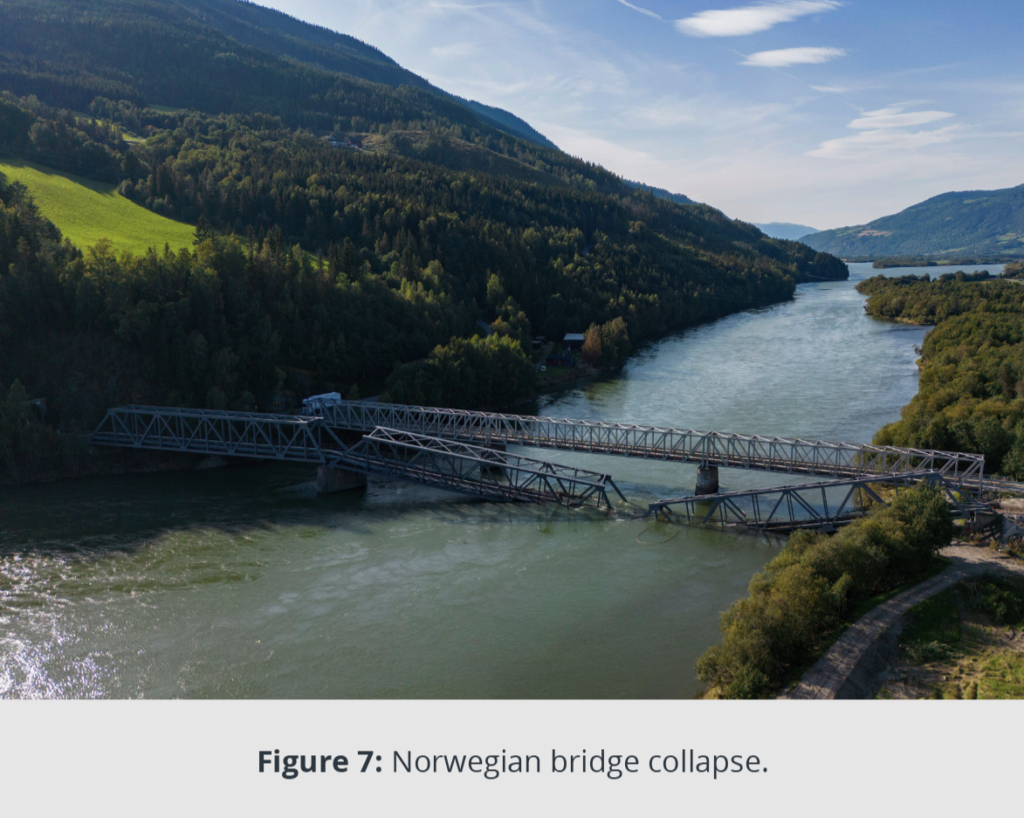
It was reassuring to hear from local staff that the bridge had been closed to railway traffic as a precaution several days before it collapsed (a lesson learnt in the UK in 1987 at Glanrhyd Bridge, near Llandeilo). And, to be fair, having rebuilt the undermined bridge pier, lifted the bridge girders back into position, and reinstated track, signalling, electrification, and communication services, the bridge reopened for railway traffic three days after our journey past it, some nine months after the collapse.
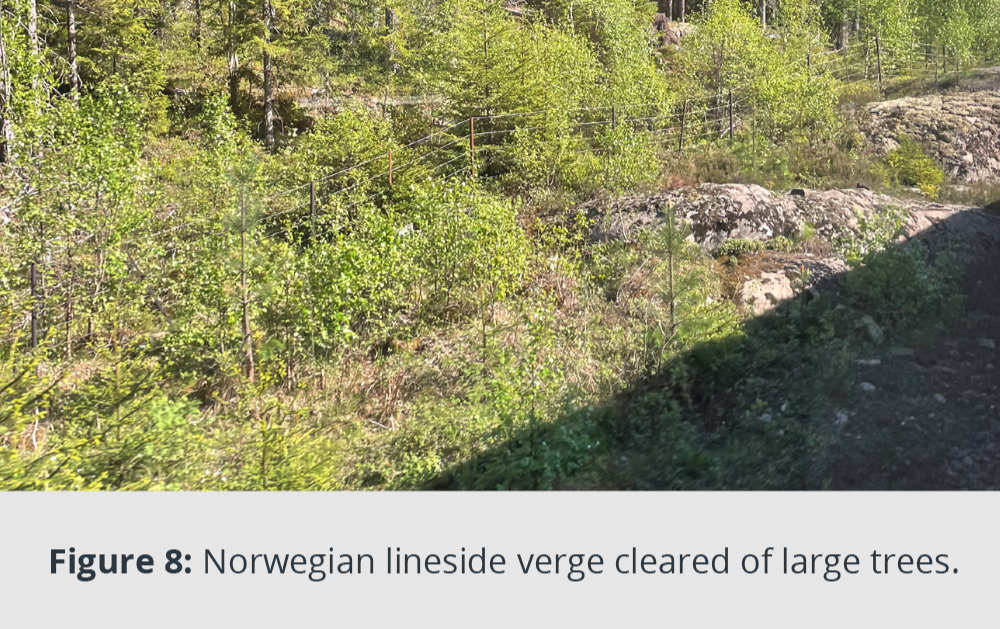
Unsurprisingly, we found large expanses of rural Norway to be heavily wooded, but it was interesting to note the 10m-15m wide verges on each side of the railway where large trees had been cleared to reduce or eliminate the risks presented by a tree falling on the track or onto the overhead electrification equipment: vegetation management in action (Figure 8).
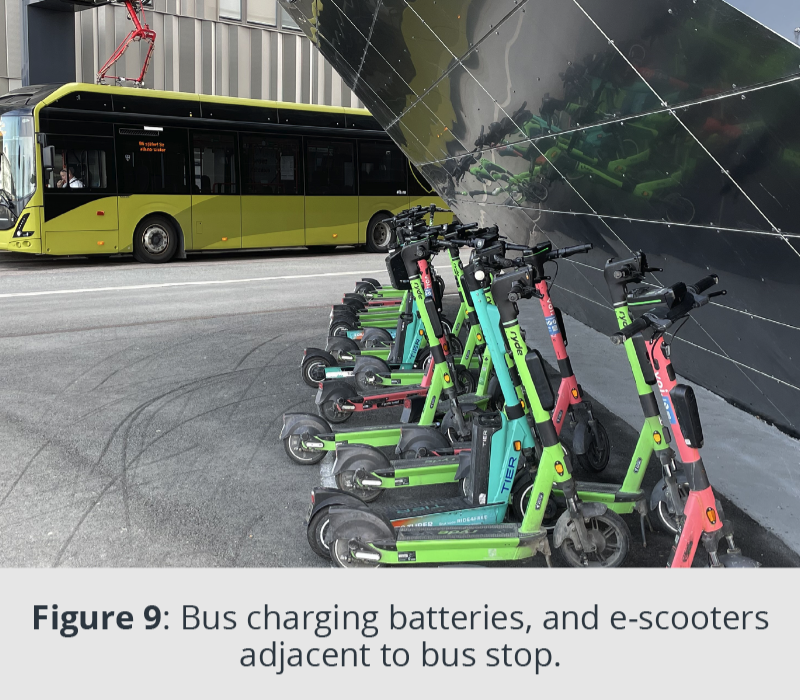
A final observation from Scandinavia is the effort that governments, both national and municipal, are putting into the electrification of public transport as a whole, and into the promotion of its use. The subsidies provided to encourage use of electric cars in Norway are well-documented elsewhere, but I was impressed by the widespread electrification of bus fleets and the extensive use of e-scooters. Though the general cost of living in Scandinavia is undoubtedly higher than in the UK, it was notable that ‘walk-up’ rail fares were generally somewhat lower! The integration of electrified public transport; rail, metro, tram, bus, and e-scooters, was well advanced in all the large towns and cities we visited and provides examples that I’m sure other countries, including the UK, could learn from (Figure 9).
Meanwhile, Back in the UK… PWI Survey 2024: Driving Positive Change
Returning to the UK, it was good to find that much progress had been made on our extensive Member and non-member surveys. Whilst these surveys formally concluded in mid-June, we decided to leave them open for input during the Rail Live event and to actively canvas responses there, particularly with a view to gathering yet further responses from non-members. The surveys were then closed to allow analysis and I hope to see the comprehensive assessment of responses prepared by our consultants towards the end of this month (July). Those responses and the conclusions we draw from them will provide one of the prime inputs to work to better define the Institution’s new mission, vision, and value statements, and to set priorities for the development of Member services.
I must thank profusely all those Members who took the time to respond to the survey, and particularly those Members who did so in detail. Having looked briefly at the anonymised Member responses, I am heartened that the overwhelming majority support the Institution’s current range of Member support services. Indeed, I can’t find much that you’d like us to stop doing! Even more important however, are the products, activities, and services you’ve suggested we might add to the PWI’s portfolio to provide even better support. All these will receive serious consideration and, while we may not be able to deliver them tomorrow, those practical ideas with high levels of support will be included in our development plans.
Having thanked Members for completing their own survey responses, I must be even more effusive in my thanks to those who took on the role of PWI Champions to take the survey out to non-members working in the railway engineering sector. The responses from non-members, now well into three figures, will be of enormous value in helping us decide how we can most effectively grow Institution membership.
I hope to be able to give wider coverage of the results of the surveys and the conclusions we can draw from them in the October Journal.
CRM – customer relationship management
I’m really pleased to report that, after a truly massive amount of work by the PWI executive team, we have started to go live with the Institution’s new Microsoft Dynamics-based customer relationship management system. We’ve opted for a ‘soft go live’ which means we’ll be cutting over functions and tasks to the new system over the next month or two, and then customising the system’s capabilities to better serve each of our Members. The system will increasingly integrate all aspects of our relationship with Members, so that each Member is offered and provided with services tailored to their individual circumstances and interests.
So, I hope that, as the year progresses, you’ll notice (perhaps small) but significant improvements in the services we offer you through our website, and in the communications you receive from the Institution. As ever, if there are aspects of the new arrangements that cause you difficulties, please let me or one of my executive colleagues know as soon as you can.
And a look to the future…
By the time you read, this the 2024 UK general election will be ‘done and dusted’. I’m not going to comment on the outcome other than to hope that whoever is now in charge of the country properly recognises the massive long-term environmental, cultural, and economic challenges we (and the rest of the world) face.
Though not much discussed during the election campaign, global warming – both how to slow it down and how to cope with it – looms large (or should loom large) in any strategic agenda. Rail-based transport – as part of a national (and international) low-carbon, properly integrated transport system – is part of the answer to those challenges. And investment in infrastructure is central to facilitating low-carbon economic growth. This Institution remains committed to supporting its Members and our industry as they work to deliver that transport system.