
(Article from Journal 2022/04 Vol140 Pt2)
I have concentrated on S&C for a number of issues, so this time I thought I would go back to plain line track and electrification and give my thoughts upon what exciting developments are around. Starting with plain line, many of us have struggled with long timbers or wheel timbers, as they say, “down south”.
I have witnessed and been involved in a few attempts to improve them including the laminated ones at St. Pancras which I am glad to say are long gone! I also had the great pleasure of being in charge of maintaining a large number, including the ones across Barmouth viaduct, that must be a record – 900 yards!
We had an excellent article in the October 2021 Journal by John Nelson and Dr. John Williams which covered the past, present and future of longitudinal bearers. Decay and deterioration profiles of timbers has been well researched and developed in recent years and solutions suggested will make quite a difference to the management of these challenging assets.
Apart from the decay, the main challenge has been track quality especially line and level and it has often been difficult to maintain and increase the line speed without completely renewing the bridges. All sorts of solutions have been used including extensive shimming but it was the first time recently I came across steel replacements.
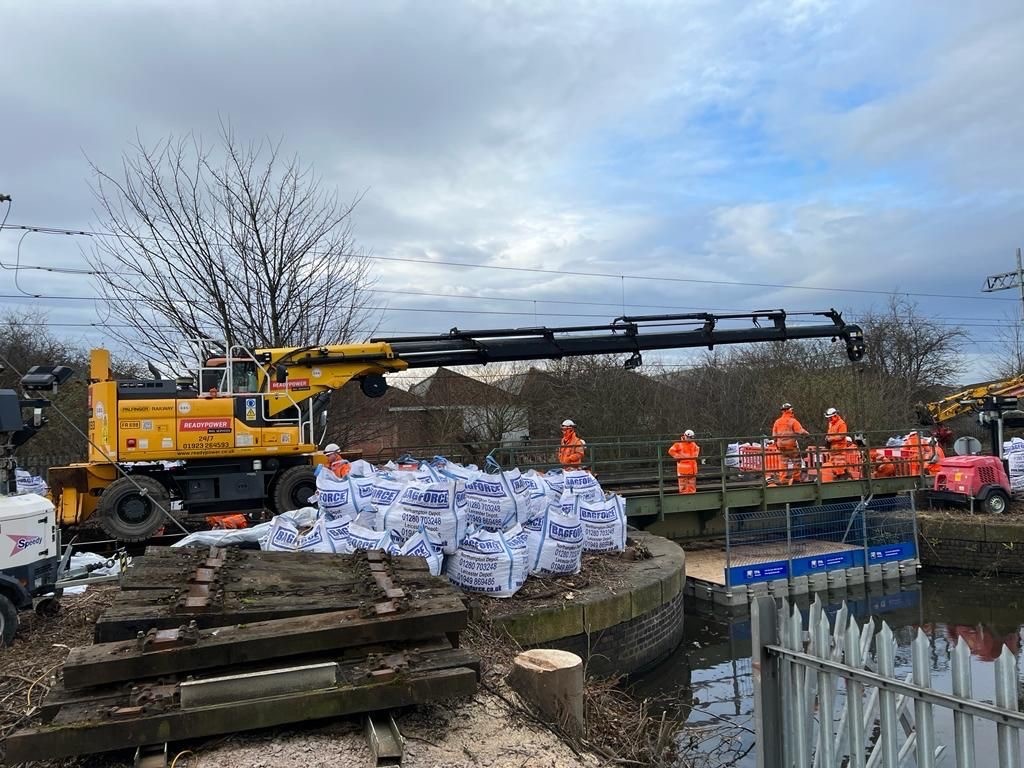
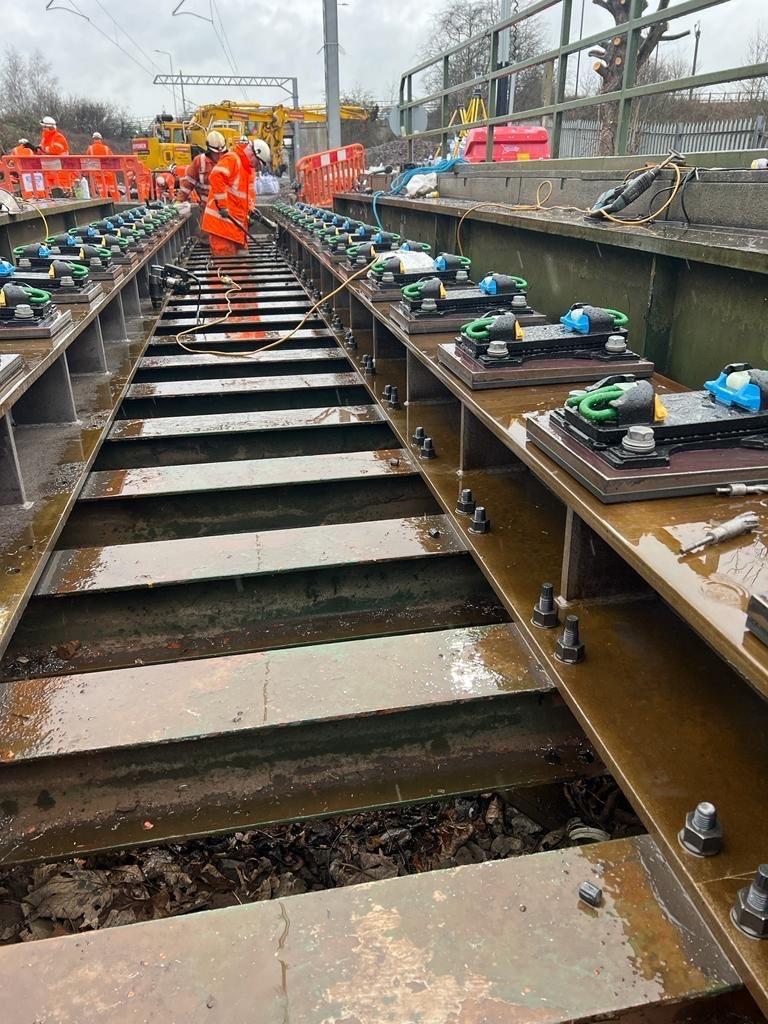
I am indebted to David Burnett and Glen Wilson and their teams led by Shaun Trickett from Doncaster Network Rail Works Delivery and Tram Overhead line teams for sharing their Tinsley, South Yorkshire experience. They carried out major repairs in a 54 hour possession to Parkgate Sluice Bridge No. 26 on the Sheffield to Rotherham line. The job overall included a CAT2 Longitudinal Timber Renewal & CAT 14 Track Renewal over the Up and Down Tinsley to increase a 35mph PSR to 55mph by correcting alignment loss caused by timber creep deterioration and unrepairable components.
A key part of the solution was the Pandrol Vipa system holding down arrangements fixed to steel longitudinal beams replacing old rail bearers and new GRP design to aid future maintenance. This was a complex job involving panel removal, installation of geocells, re-railing, reballasting, and fly ends over 40m. The Sheffield Tram Train electrification complicated the work as did the fact the bridge is over the redundant Fitzwilliam river waterway.
David was pleased to tell me how invaluable his partners were and his absolute reliance upon their expertise and specialism. These included Trackwork, Ainscough, CML, Lanarkshire Welding, Readypower Group, pbh rail, Shortterm, XYZ Rail, High Motive, Mac Rail, Torrent, and Pandrol.
TECHNICAL
The year started off with a bang, I opened the first PWI Lunch & Learn on 18 January with 85 attendees, this has continued alongside face to face and virtual Section meetings. We had a great seminar in Manchester in March on Climate Emergency and Decarbonisation. This was well attended and all speakers were focussed, from the young to the more senior with great ideas for materials and systems that can be adapted and adopted. The news of a massive expansion in Railfreight was fascinating as was the statement that we can make 1 km of track out of turning six million plastic bottles into composite sleepers! Our Practical Trackwork Challenge went ahead at Churnet valley and this will be reported upon in the next Journal.
REFLECTION
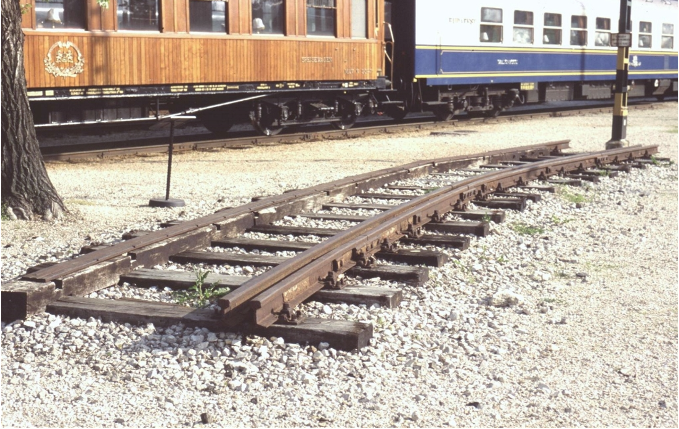
In January, I asked about the reasons why this particular S&C layout in Bulgaria (image 3) had a plate and a timber; I did receive one or two suggestions. I wonder if they are right?
Mervyn Kendall said, “This form of trackwork is normally found in industrial areas and docks where there is a need for tight curves to suit the site layout. The right hand running rail as viewed together with the check rail keep the wheels on the rail with the check rail preventing any sideways movement. To allow the wagon to traverse the curve the left hand rail is omitted as this would either prevent the wagon from moving due to it binding between the rails or, more likely, the left hand wheels would ‘ride up’ over the rail – as British Rail found when they tried to use the Skippers on the Gunnislake branch. The left hand wheels still need supporting so the plates are laid allowing the wheel flanges to run on the surface. You will find that the plates are laid lower than the opposite running rail by the depth of the wheel flange which is a standard measurement in most countries.”
Richard Green said, “When negotiating a curve, the outer wheels have further to travel than the inner wheels. On a road vehicle, a differential gear allows the outer wheels to rotate faster, and so travel further, than the inner wheels. This, though, has never been the practice on the railways, where fixed wheelsets are the norm. Rounding a modest curve is made possible by the tapered conical profile of the wheel treads, which effectively adjusts the wheel diameter as required. If the curvature becomes too severe, one or both wheels have to slip, with consequent additional wear to both wheels and track. By allowing the outer wheels to run on their flanges, their effective diameter is increased and so they do not need to rotate so fast. Ideally, their speed of rotation would perfectly compliment that of the inner wheels. If the plates are laid lower than the corresponding running rail by the depth of the flanges then, any undesirable tilt is eliminated.”
AND FINALLY…
Although I specifically said I would not discuss S&C, I was sent this picture recently. What an amazing landscape of iron, it makes our maintenance work look easy – come on, someone will be able to give me the location? (Image 4).
(Image Plymouth Railway Circle)
