

As the incoming chair of the PWI Climate Change and Decarbonisation Committee, my first task was to attend an online government led environmental forum. The Westminster Energy, Environment & Transport Forum policy group held a virtual conference on 27 September entitled; ‘Priorities for climate adaptation and resilience in the UK’. The opening presentation was given by Baroness Brown, Chair, Adaptation Committee, Climate Change Committee (CCC) and covered ‘The Current outlook on vulnerabilities and resilience in the UK to climate change, and requirements for achieving successful adaptation.’
The first section focused on an assessment of current knowledge and progress toward net zero. Baroness Brown started by confirming the current UK experience of a rising rate of hottest daytime temperatures showing the acceleration of temperature rise since 1960 and the effects the UK is experiencing on:
• deaths due to heat exposure
• overheating infrastructure (houses, hospitals etc)
• economic output
• spread of pests and disease
• water shortages
• flood risks
• impacts on agriculture and forestry – the need to continue growing food in ever more challenging conditions at home and abroad.
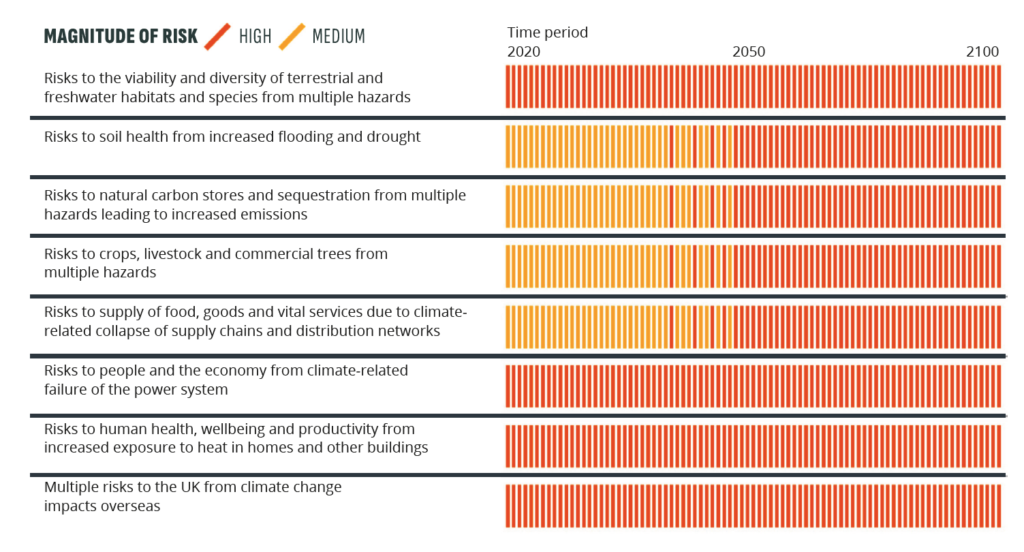
From the above the CCC have identified 8 priority areas for urgent action in the next 2 years influenced by upcoming legislation opportunity.
Clearly operation of a reliable, resilient railway is implicit in a number of these risks. It was also repeatedly pointed out during the conference that a ‘systems’ approach must be taken to address these risks as there are many interdependent factors at play e.g. rail transport and power supplies.
A key message the CCC has conveyed to the government is the need to start with a clear vision ensuring the UK population understands what a well-adapted UK will look like and what needs to be done to get there from a business and a personal perspective. This, it’s hoped, will galvanise efforts in achieving net zero.
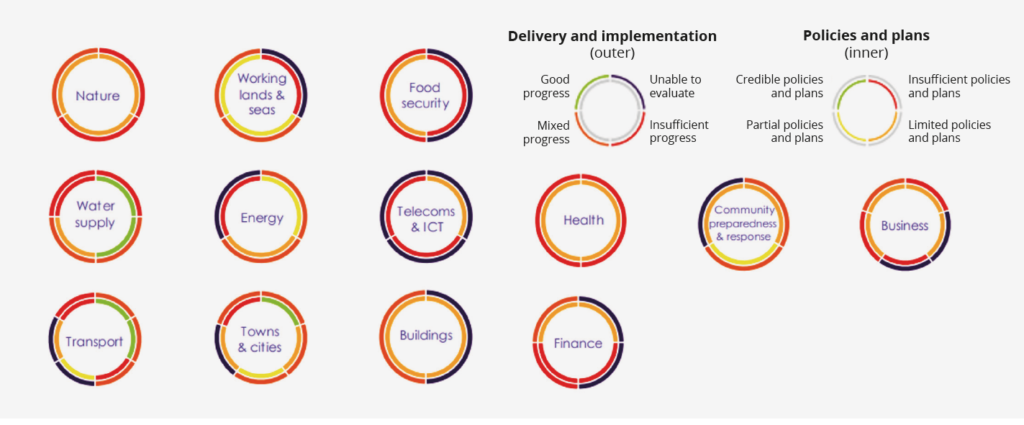
Baroness Brown gave an assessment of where the CCC believe the UK progress is currently in two respects shown on the graphic below.
Policies and plans – inner ring
Delivery and implementation – outer ring
At a very high level, this graphic confirms that some progress is being made on government policy and plans; however implementation and evidence that a difference is being made is still ‘insufficient progress’ or ‘not possible to evaluate.’ So overall the UK has made a start on policy and plans but is way behind with where we need to be on implementation. Transport typifies this assessment.
The next set of presentations focused on the latest thinking regarding ‘vulnerabilities of key sectors – how resilience can be strengthened across nature and ecosystems, food and health, utilities and infrastructure, and society and the economy’ and saw contributions from:
Jim Clark, Public Affairs Manager, Zurich Insurance Dr Jens Evans, Senior Adaptation Advisor, Environment Agency Richard Bramley, Chair, Environment Forum, NFU Ken Kaar, Associate, Burges Salmon David Wright, Group Chief Engineer, National Grid
Of most direct relevance to the railway was from the National Grid (NG), given the similarity of the distributed network of assets NG operate. David Wright explained NG’s risk-based approach to understand the vulnerability of grid assets, but more can be learned from further dialogue with NG.
A number of the speakers made reference to the sometimes confusing terminology around actions for climate change highlighting that resilience comes in a number of forms. Often the term resilience is used for mitigation actions designed to address relatively short term climate affects. These reactive options attract funding as the short term benefits are tangible and measurable. The goal however has to be long term resilience (adaptation) to transform the way the population and businesses operate as temperatures rise over the next decades until net zero is achieved. Funding for these transformational actions however, is much more difficult to attract in a free market and needs government policy and financing to ensure these essential steps are undertaken.
A presentation on public awareness of climate change highlighted the changing public perception over time. Perceived risk associated with COVID-19 and the cost of living crisis pushed the perception of climate risk to a lower level through the early 2020’s but the extreme weather events experienced this year has again raised this public risk perception through 2023 .
Dan McCartney, Head of Climate Adaptation, Department for Environment, Food & Rural Affairs (Defra), rounded off the conference where he outlined the next steps contained in ‘The Third National Adaptation Programme (NAP)’. The NAP sets the actions that government and others need to take to adapt to the challenge of climate change in the UK over the next five years and imposes legal duties on public bodies and major infrastructure providers. It builds on the previous NAP by considering 61 risks including international risks impacting the UK. One highlight from the infrastructure section on transport includes DfT consulting on a new transport adaptation strategy putting the sector on ‘a pathway to a transport system that is responsive to climate change’. Defra is strengthening governance around adaptation actions through government departments and regulators and a new cross government resilience board to oversee progress.
TO FIND OUT MORE YOU CAN VISIT THE PWI WEBSITE WHERE YOU WILL FIND ALL PRESENTATIONS FROM THE DAY AND A VIDEO OF THE FULL PROCEEDINGS. YOU CAN ALSO FIND MORE INFORMATION AT THECCC.GOV.ORG WHERE CCC REPORTS AND COMMUNICATIONS CAN BE FOUND