

The PWI’s sixth Practical Trackwork Challenge (PTC) took place on the Midland Railway Trust (MRT) heritage railway near Ripley, Derbyshire on 22 and 23 March 2023. The challenge is a great opportunity to take part in permanent way work in a protected, low risk environment. As the industry works ever harder to reduce workforce exposure to operational railway risk, it is difficult for many
people engaged in railway infrastructure engineering to gain experience of working on track. The PWI are delighted to offer this personal development opportunity on a regular basis to our Corporate Members. Long before the Challenge took place, a significant amount of time had been dedicated to planning the event.
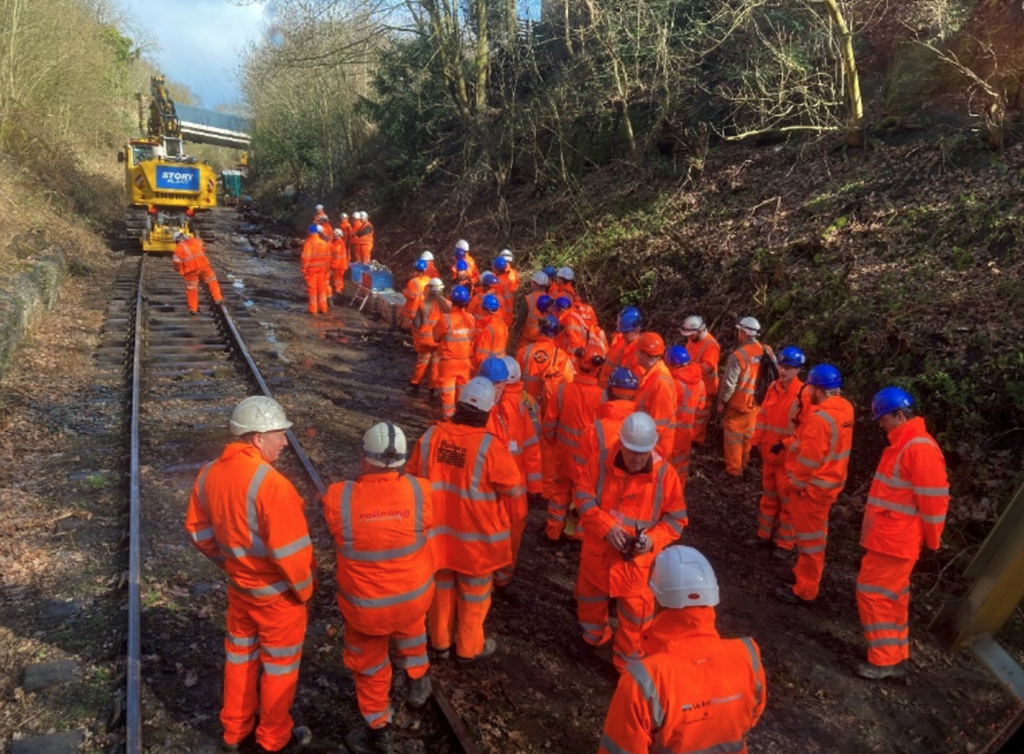
There were three principal worksites in operation over the duration of the event. The first site was located in a cutting near Ironville Junction. The work involved re-sleepering and re-ballasting of approximately 140m of bull head plain line. Worn out timber sleepers were replaced with second hand concrete sleepers and the original ballast replaced with new stone. Representatives from Korec had surveyed the site in advance and AECOM prepared a new design for line and level. The ballast was removed by Railcare’s Railvac, a specialist machine best described as a huge vacuum cleaner.
Once the ballast had been removed from the first six or seven consecutive sleepers, space was available for Story Plant’s road rail vehicle (RRV) to remove the old sleepers to lineside, thus creating a gap for the second hand concrete replacement sleepers to be installed. Removal and reinstatement of the timber sleepers was undertaken by the RRV fitted with a sleeper grab. Following the sleeper replacement, the RRV changed its attachment to a ballast grab bucket and unloaded sufficient ballast, from a trailer behind the RRV, to safely pack the track. Staff from the MRT and Vital Rail supported
the operation with fastening removal and insertion. Railcare had also supplied their ballast insertion OTM that was used to ‘top up’ the ballast profile.
The MRT is formed mainly of bullhead track and so far as the PWI are aware the timber sleeper changing process adopted, using a Railvac and an RRV working in partnership, was the very first time this had been used. Trials had taken place before the Challenge that were successful but the production on this site was severely hampered by water ingress from a broken drain.
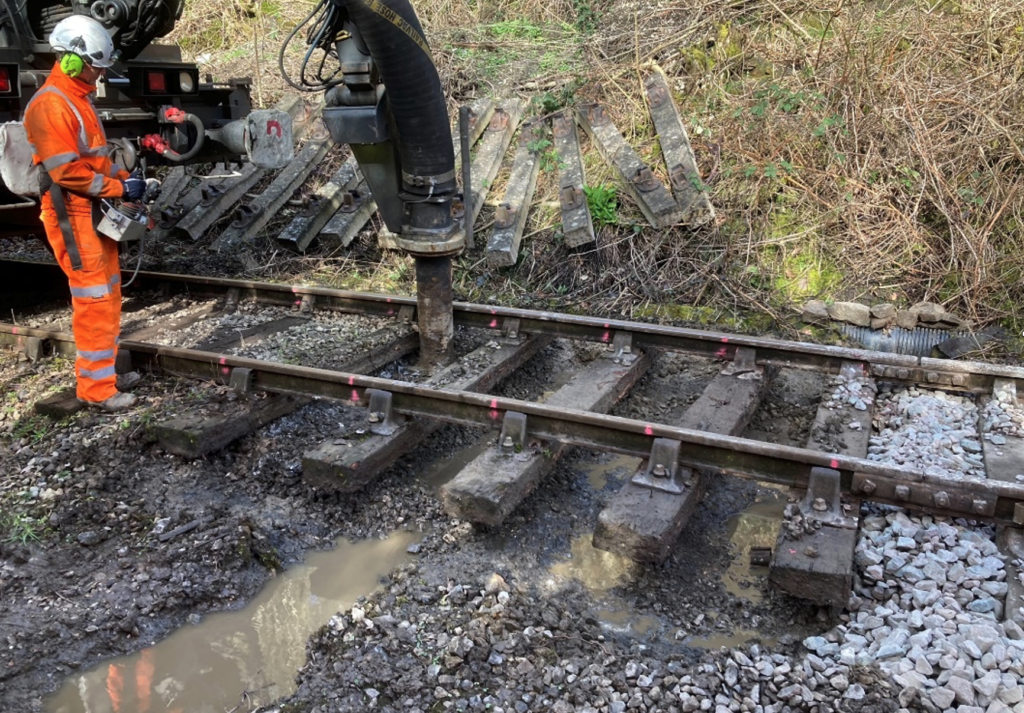
Reballasting conditions were very challenging (Photo courtesy D Ratledge)
The second operational site was in the vicinity of Butterley station where Swietelsky Babcock’s Unimate 09-4×4 dynamic tamping machine undertook a series of maintenance tamping operations on the first day and then tamped in the Swanwickstation area and the Ironville site on the second.
Delegates were shown how the machine can survey the track, develop the design and then align the track to its designed level. The crew could not have been more helpful in explaining the technology that enables this to take place. Many of the more mature PWI members on site could only marvel at the enhancement of tamper capability over the last forty years or so.
The third site was at Swanwick station where refurbishment and maintenance techniques were demonstrated on a unit of Switch and Crossings (S&C). A turnout in the sidings
was used as a demonstration site where Neil Denton shared his knowledge on the complexities of S&C. With his personal background in both manufacturing and then maintenance with Network Rail, Neil showed delegates the advantage in using back to back gauges, squaring switches and the importance of correctly identifying components before placing orders for their replacement. He was ably supported by members of the S&C Alliance who demonstrated how the use of a number of other products such as Interflon lubricants, DWG Spikefast and Staytite fastenings are helping in the maintenance of jointed track and switches.
Exhibitors and presenters at Swanwick station included:
• Railcare Ltd who explained the versatility of the reballasting system and gave a presentation on their companies products.
• Volker Fitzpatrick where the overall Volker Wessels group was detailed and the services from each of this multi-faceted group of companies, including Volker Rail, was explained.
• Robel and Cembre who both showed their extensive array of plant that already supports much of the railway industry in the UK and worldwide.
Conclusion
The PWI’s sixth Practical Trackwork Challenge was a testament to the power of hands-on experience and collaborative learning. Over the course of the event, participants got to witness and engage in comprehensive trackwork operations, from re-sleepering and re-ballasting to maintenance tamping operations and switch and crossings refurbishment.
The challenge, held at Midland Railway Trust, presented a unique opportunity for industry professionals to gain invaluable experience in a low-risk environment. It demonstrated innovative techniques and offered practical insights into the workings of the railway infrastructure.
The event was not only about learning new skills but also about understanding the importance of safety and efficiency in railway operations. From the first site at Ironville Junction to the final demonstrations at Swanwick station, each activity was designed to enhance understanding and foster professional development.
Despite challenges like water ingress from a broken drain, the participants showed great resilience and adaptability, further proving the value of such immersive experiences. The event also highlighted the remarkable advancements in technology within the railway industry, particularly in tamper capability.
We extend our gratitude to all participants, exhibitors, and presenters who contributed to making this event a success. The sixth PWI Practical Trackwork Challenge has set a high benchmark for future events, and we look forward to continuing to provide such enriching opportunities for our corporate members.