
By the time you read this I will be at the halfway point of my Presidential year. My aim is to visit every Section during the year, that plan is progressing well. The core of my message at those sessions is that for the PWI the importance of growing and retaining the membership can not be overstated.
Economically the country is in turmoil, the railway is by no means immune to that and we can anticipate that the industry will have less to spend. The effects of that are certain to be felt by us all. That helps to emphasise the critical need for the PWI to provide relevant services and valuable support to all its members, both individual and corporate. I am sharing my views on what I think PWI should do as part of my message at Section meetings (and to anyone who will listen).
But frankly what I think matters little, it is the thoughts that are shared at those meetings and in those conversations that is truly helpful. The Institution will have a long life beyond my Presidency, Stephen Barber is leading the Executive in building a 5 to 10 year strategic plan for the PWI and I know that he will consult widely on that. I hope that the conversation I am prompting will help in generating a rich response to that consultation.
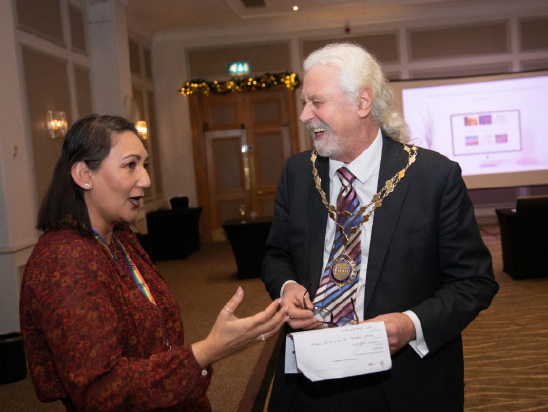
With the world now opened up after the two years of Covid lockdown we are able to meet again face to face. I am writing this having had the great pleasure of hosting the 2022 PWI Celebration Event in Birmingham. Our excellent guest speaker was Mona Sihota, the Network Rail Head of Drainage and Off Track. Mona shared with us her journey as an Engineer. Like many among us she put off taking steps to seek professional registration. Her story was like many plagued with self-doubt, not finding time and living in denial. From Mona the message was clear, no one should need be in that position, and now as a Chartered Engineer she is committed to helping others with their personal development. That message could not have been any better for the event. I presented certificates of achievement to 40 people. For some we were celebrating professional registration, for some celebrating completion of educational courses. I was particularly pleased to be able to congratulate the first group of Electrification Engineers on completing the new Electrification Diploma. The energy in the room during the evening was palpable, we were celebrating the successful outcome of individual effort and I hope that the future will hold many similar celebrations of personal achievement.
What all those recognised at the event achieved brings me back to my themes about what PWI does for its members. We offer, I think, a superb range of support in aid of that personal development. The late Alison Stansfield was instrumental in embedding that in the PWI DNA. My view is that we provide the best range of focused training and education available to Railway Infrastructure Engineers. The work on that is ongoing, and over time more will be added. We also have the most supportive, helpful and easily understood registration processes available. These are our unique selling points and we should celebrate those too.
Another way in which we can gather together again is at formal seminars and conferences. In November we gathered in Bristol for the Sustainable Infrastructure: Design and Maintenance seminar. The presentations at the seminar were both informative and thought provoking. The theme was sustainability and two things were clear. Within the rail sector a lot of thought and effort is being focused on these wide questions. We heard about cutting out waste, understanding embedded carbon, reducing emissions due to hauling heavy materials to site and some really useful tools to calculate carbon and other pollutants. It was great to see Deputy President Chrisma Jain taking the chair for part of that conference.
So that brings me round to offer a brief update on my view of where our industry is, from the perspective of my personal involvement in some related topics. I have been working with the National Engineering Policy Centre (part of the Royal Academy of Engineering) advising government on hydrogen towards net zero. In the light of the economic turmoil and the challenges in energy supply inflicted on Europe, the MP Chris Skidmore was asked by the Prime Minister to review the 2050 commitments. That of course is a wider question than just hydrogen, and the NEPC were asked to contribute. I was able to inject into the NEPC response a significant input on the importance of protecting the investment in rail to secure the strategic freight network, and thus facilitate the modal shift of container freight from road to rail. I set out how that would involve addressing gauge works at bridges and tunnels, followed by roll out of electrification.
It is disappointing that government(s) seem to have reverted to fossil fuel to address the current crisis in energy supply. What I hope is that this will soon reverse and the reality of climate change will be more dominant in policy on energy. Whether that happens or not the reality is of course that the ambitious plans for conversion of more of the railway to electric traction will slow down. It is already clear that the plan to electrify a further 13,000 kilometres of line by 2050 will now extend out to 2070 or beyond. I can’t help reflect that whilst the slower progress may well be economically based, some will be seeing the kicking of the can down the road as opportunity for imagined alternative technologies to emerge.
Specifically on the subject of climate resilience, summer 2022 saw extreme heat, and whilst our railway was kept safe, it is difficult to describe performance as a success. I was invited to join a task force under the chair of Sir Douglas Oakervee to enquire in to what happened and why, and importantly recommend how in future years we might manage better.